
Slot Machine History
The Fascinating History of the Slot Machine
SLOTKER®’s roots run deep, way back to the early 1890s, with the original mechanical inventions that have evolved into today’s modern-day slot machine industry.
1891 – Sittman and Pitt
In 1891, Sittman and Pitt, a commercial partnership in Brooklyn, created a coin-operated poker machine that consisted of five drums (comparable to reels) that displayed 50 card faces, which became very popular gaming devices in saloons and bars around New York, and soon after, gained national popularity.
As poker players know, a standard poker deck has 52 cards per deck. Whether it was a mechanical difficulty to spread 52 cards across five drums, or to limit players from making high-ranking combinations, the missing two cards were the Ten of Spades and the Jack of Hearts, which eliminated two possibilities of hitting a royal flush.
Because there were thousands of possible winning combinations, these machines couldn’t calculate payouts automatically, so winners had to collect prizes, such as beer or cigars, from the bartender.
1893 – Gustav Schultze (No. 502,891)
In 1893, Gustav Schultze, a German-American inventor and machinist based in San Francisco, created and patented a slot machine called the Horseshoe. Instead of drums or reels, Schultze’s machine used a single spinning disk (also referred to as an upright wheel machine), that featured 10 Horseshoe symbols, 1 Joker, and 14 blanks (losing spaces, similar to blank spaces on modern slot machines).
The innovation of Schultze’s Horseshoe machine is that it was the first slot machine that had an automatic payout mechanism, engineered by internally using a notched gear (or star wheel) on its internal spindle (like an axle of the wheel on a car), and if the disk stopped on a winning horseshoe symbol, the notch allowed a lever inside the machine to push coins out of a payoff tube.
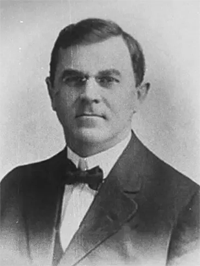
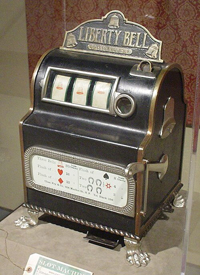
KayiGacor, CC BY-SA 4.0, via Wikimedia Commons

1894 – Charles Fey
Like Gustav Schultze, Charles Fey was a German-born immigrant and a colleague of Schultze, with both men putting roots down in SanFrancisco. Fey had a background of making and repairing precision navigational instruments, and previously worked as an apprentice in the nautical instruments department of a British shipyard for about five years.
Fey was instrumental in Schultze’s success with the Horseshoe machine, having provided him with the precision-machined parts, such as the internal gears, necessary to make it work.
While Schultze’s Horseshoe machine was becoming more popular and successful, Fey was perfecting the same concepts of the Horseshoe’s single disk mechanics to develop a new mechanical device that would work with three “reels” instead of a single “disk.”
Between 1894 and 1899, Fey introduced a series of new machines – first, an improved version of Schultze’s Horseshoe machine, secondly, “the 4-11-44” (a 3-disk floor-standing machine, popular in local saloons, paying out for a rare “4-11-44” sequence), thirdly, the “Card Bell,”
featuring playing card suits – but, finally, the one Fey became famous for was the Liberty Bell, which was an improved or upgraded version of his previous “Card Bell” machine.
Fey’s Liberty Bell slot machine became so popular that he couldn’t keep up with demand. And because gambling was illegal at the time, Fey didn’t patent his designs or machines, which allowed competitors to create similar knock-offs. Fey had created a three-reel mechanical system that automated different payout amounts for different slot symbol combinations, in a way that was never achieved previously. And since this was such a groundbreaking and industry-changing invention, Fey is considered to be the inventor and father of the modern-day slot machine. His Liberty Bell slot machine established the universal standard for slot machines for the next 75 years.
The symbols Fey used on the Liberty Bell included, the Liberty Bell, a Horseshoe, and three of the card suits: Hearts, Diamonds and Spades, interestingly omitting Clubs.
1907 – Fruit Symbols
Because of anti-gambling laws, slot machines were presented or sold as “vending” machines, and in 1907, the Mills Novelty Company of Chicago (owner Herbert Mills) introduced a machine called the “Operator Bell,” which was a modified version of Charles Fey’s original Liberty Bell slot machine.
And to support the idea of a slot machine being used as a vending machine, Mills used fruit symbols on the reels: cherries, lemons, oranges and plums, which specified the flavors of chewing gum (made by the Bell-Fruit Gum Company) to be awarded as prizes when those symbols lined up, instead of an illegal gambling payoff in coins. However, in private settings, winners did collect cash or coin prizes, as under-the-table gambling was somewhat common.
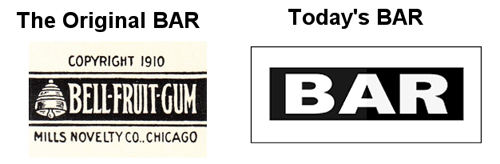
In addition to the fruit symbols, Charles Fey’s Liberty Bell was adopted as one of the symbols on the Operator Bell slot machine. And then there’s the BAR symbol on the Operator Bell, which started out as the logo of the Bell-Fruit Gum Company (or a stylized version of their gum wrapper), which was a black stripe or rectangle across the reel, and with white lettering on the black background: a bell graphic followed by: BELL-FRUIT-GUM. And above or below the logo, in smaller text, “COPYRIGHT 1910,” “MILLS NOVELTY CO.,CHICAGO.”
In those early days, for better visual clarity and a simpler aesthetic, the black-and-white BELL-FRUIT-GUM logo, was simplified and transformed into a black rectangle with the word BAR in white, and is still a widely-used and iconic slot symbol, often associated with larger payouts or jackpots.
2026 – SLOTKER®
Today, SLOTKER® honors those early slot-machine pioneers, inventors, mechanics and engineers, from Sittman and Pitt, Gustav Schultze, Herbert Mills and inventor extraordinaire, Charles Fey.
Their creativity, skills and ingenuity paved the way for the world of slots today! And now SLOTKER® playing cards and games honors those early pioneers and follows that nostalgic tradition using the same iconic, classic, vintage and much-loved symbols… LEMONS, CHERRIES, ORANGES, PLUMS, BELLS and BARS.